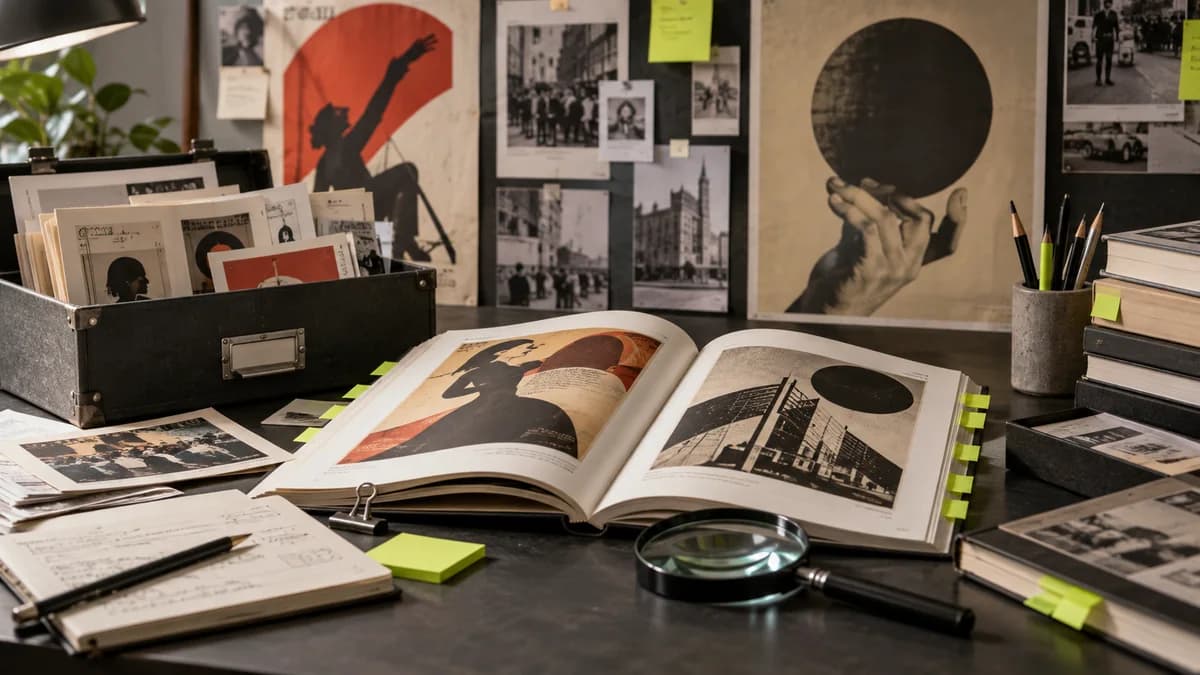
Design history and poster archives should be examined to understand decisions, not to get ready-made formats. Reading the context of the work makes it easier to develop original ideas.
Read the image together with the conditions under which it was produced
Research which audience a poster reached, in which place and with what production possibilities. A choice that seems simple today may be related to the print constraints of that period. Do not trust information in a social media post without verifying the date, designer and source of the work. Distinguish between archive recording and comments added later.
Extract principle instead of format
You can examine a strong diagonal placement, the relationship between the photo and the text, or the limited use of color. Carrying the same letterform, symbol and composition of the reference together will take you away from the original solution. Try the principle you are examining with your own text and a different visual material. If the outcome looks similar, go back to a more fundamental decision level.
Link art review to design question
Direction of view or layered narrative in an image can help consider the reading flow of a current campaign. For this, it is not necessary to make big generalizations about the artist. Explain which detail contributed to which design decision. Do not present your interpretation as historical fact; Keep evidenced knowledge and evaluation separate.
Check image usage rights separately
Just because a work is found on the internet does not mean that it can be used freely in a commercial project. The rights conditions of the work and the photograph used may be separate. Read the descriptions on the relevant registration page of the museum or archive. Store the source link in the reference board; Complete the necessary rights control for the images to be published before the project is delivered.
Convert poster archive to a review file
Select a poster from institutional archives, such as the University of Michigan's Labadie collection, and note the date, designer name if available, technique, and registration link. Then write down your own observation separately: what is read first, how the image and text relate, which gap directs attention? Do not turn information that is not in the archive into historical fact by guessing.
Comparative study instead of list of famous designers
Instead of declaring one designer “the best,” examine two different solutions with the same question. Do not reduce the results to a single approval score if the context in which they are produced varies. As a Graphic Design graduate of Marmara University Faculty of Fine Arts, the approach I recommend in the training content is to explain the reference and develop a unique solution to your own brief. Graphic design lessons guide continues this view with practical exercises.
Study designers with concrete examples
Scher, Kare and Vignelli review guide, prepared through typography, icon and visual system, relates these questions to different fields of study.
Read İhap Hulusi Görey and his nostalgic posters in context
When researching İhap Hulusi Görey's posters, proceed from the records of museums, archives and research institutions instead of images whose source is not specified. If there are discrepancies about the date, designer, and different versions of the work, do not hide it. Salt's Suavi Sonar review provides a concrete example of why attribution in design history narratives must be checked against sources.
Instead of transferring the limited colors or strong figure of an old poster to the current brand, examine what communication problem it solves. Movie posters, exhibition catalogs and magazine covers can also be read with this method: initial focus, order of information, period condition and audience relationship are noted separately.
Turn design blog and movie suggestions into research notebooks
When choosing sources, give priority to publications that describe the author, date, and work cited. While watching a movie, you can write your own observations about color and framing; Don't present this as the verified intent of the film's designer. Music can accompany the work, but don't make any definitive promises that a particular playlist will boost everyone's creativity.
The fact that a famous person has studied graphic design should not be the only reason for choosing a department. Verify educational background from reliable source; Make the main comparison based on course content, production and feedback. Selçuk Aker's training guide connects this research to your own goals.
Frequently asked questions
How to develop an original design idea by examining an old poster?
Research the context in which the poster was produced, its audience and information priority. Then, instead of moving the format, try the principle you learned in a different context and usage condition.
What should be written in the reference note in a design history study?
Record the source of the work, its designer, and the decision you reviewed. Explaining a principle like typography, scale, or repetition in your own words is more instructive than a pile of random images.