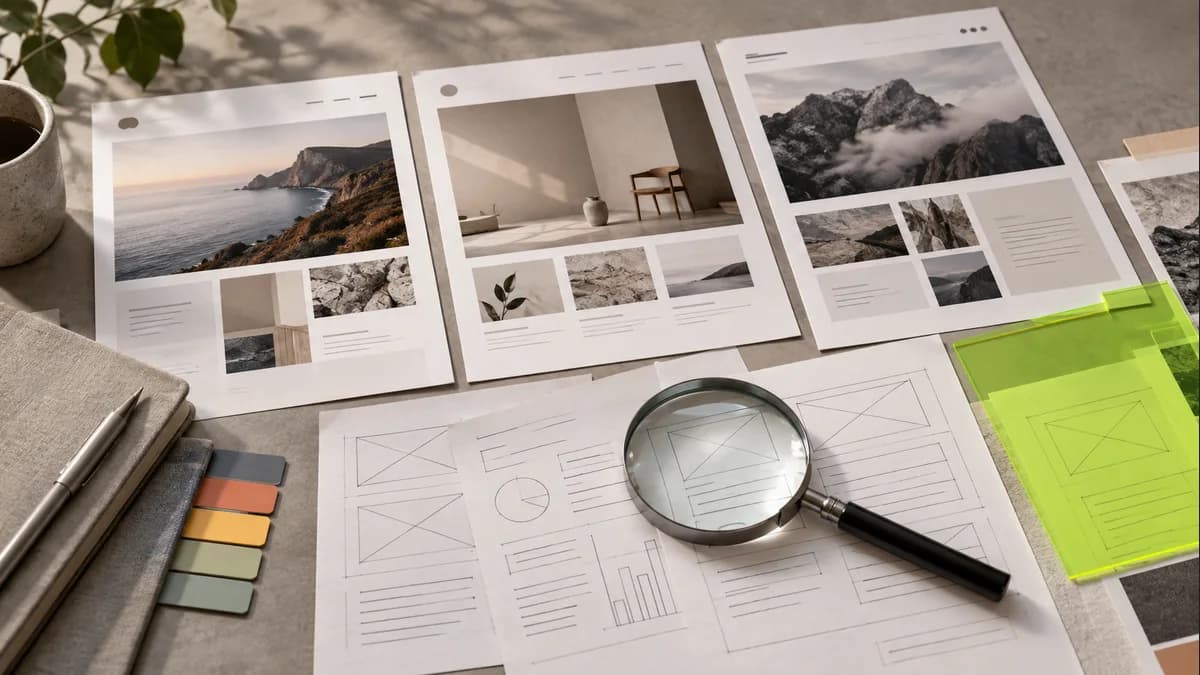
Competitor analysis for design does not mean copying another brand's colors or text. It is to examine how the user compares the options, what information they find, and which questions remain unanswered. As Selçuk Aker, I translate findings into design decisions that fit your content and service scope.
Which competitors should be compared?
Consider alternative solutions for the user along with businesses that offer the same service. Someone looking for a corporate catalog can decide between an agency, a freelance designer or a ready-made template. The three are not the same production model; analysis should make this difference visible.
Don't accept a competitor as successful just because he or she is at the top of the search. Advertising results, organic results and appearances that vary depending on the individual are separate. Do not present assumptions about a competitor’s sales performance as facts without access to relevant traffic or conversion data.
Comparison table
| Area examined | Observation to be recorded | Our decision |
|---|---|---|
| First message | Are the service and audience clear? | More concrete value proposition |
| Service scope | Are deliveries and limits disclosed? | Clear scope and preparation checklist |
| Portfolio | Is there role and project context? | Actual task and delivery description |
| Navigation | How to access important information? | Menu by user task |
| Contact | What does the form want? | Minimum information required for quotation |
Separate observation, comment and suggestion
“There are ten fields in the competitor’s form” is an observation. “These fields are too many for everyone” may be an unresearched comment. “What fields are necessary for our bidding process?” It is a practical question. Separating these three levels in the analysis file avoids false precision.
For example: if the competitor offers the technical document visible on the product page, instead of copying the same layout, determine which document your customer is looking for and when. The document's name, version, and matching with the relevant product may be more important than its image location.
Converting the analysis into a design brief
Write down the three most important information gaps, the brand elements to protect, and the user task to test. Include a content source and contact person for each recommendation. This file is more useful than a mood board consisting of just screenshots.
We can determine your area of differentiation through brand design, web design service and my work. My experience of running different materials together for Pedaş is that the visual direction chosen as a result of competitor analysis remains consistent across applications; It is not a solution copied from competitors.
Frequently asked questions
Is it enough to use it by changing the competitor’s text?
No. Create original content based on your own service, experience and your customer's questions. Changing the words alone can repeat the same narrative.
Can I learn the competitor's conversion rate by looking at their website?
No. Publicly available design observations are not actual account analytics. Unverified success figures should not be included in the analysis.
How many competitors should be examined?
It is important that they represent different solution approaches rather than numbers. Instead of duplicating the same types of sites, choose relevant and comparable examples.


